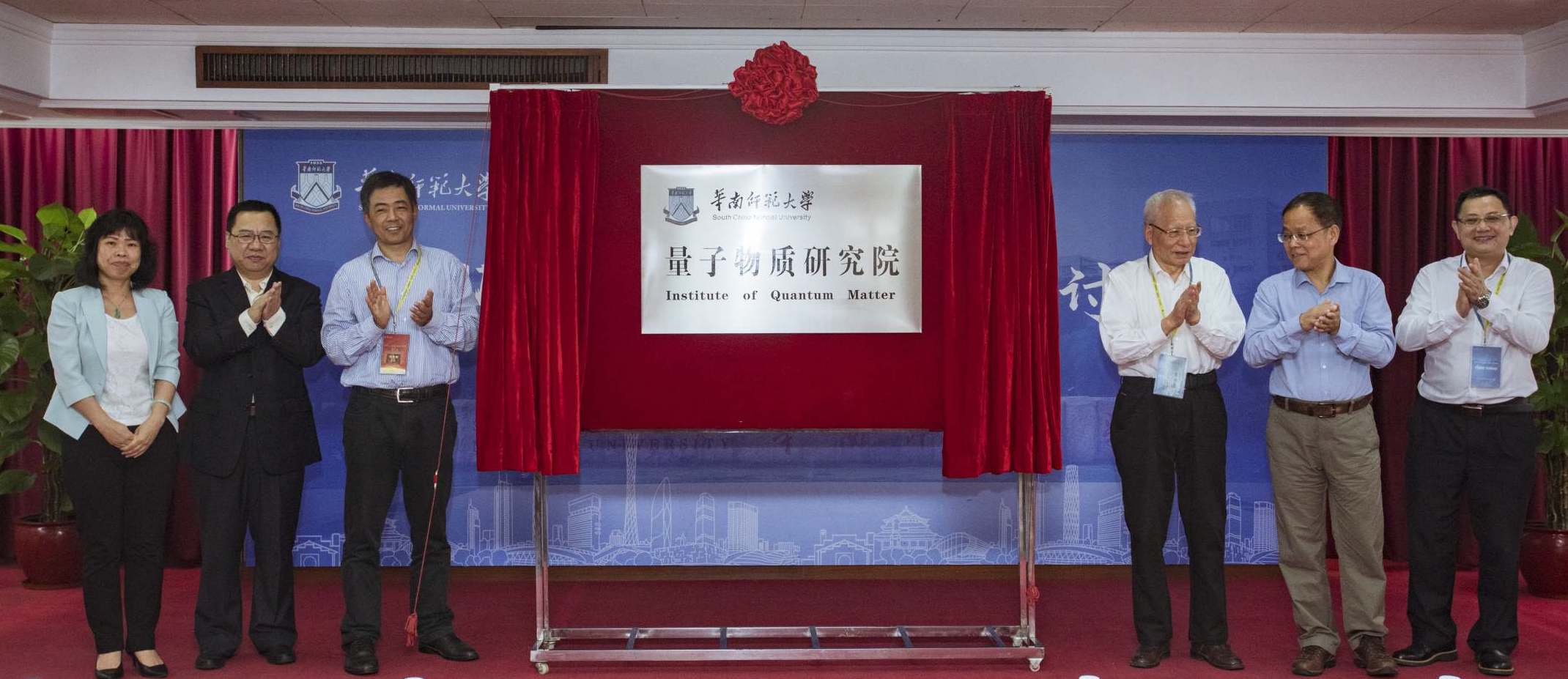
量子物质研究院成立于2018年7月,是华南师范大学直属的独立二级科研机构,由王恩科教授担任创院院长。华南师范大学物理学学科于2017年和2022年连续入选国家“双一流”建设学科,量子物质研究院作为该学科的重点发展方向——粒子物理与原子核物理的主体建设单位,围绕四大研究领域展开布局:核物理(重离子碰撞物理、核子结构、低能核物理实验)、粒子物理理论(粒子物理唯象学、量子场论)、高能物理实验(CMS、LHCb、STAR、BESIII国际合作实验)以及高能物理先进计算(格点场论、量子计算、人工智能)。研究院目前共有教职工42人,其中长聘教师19人,青年英才与博士后14人;人才队伍中包括国家杰出青年科学基金/长江学者特聘教授获得者5人,国家“四青”人才6人。
量子物质研究院积极践行学科交叉融合的创新机制,着力推进有组织的科研体系建设,平台建设成效显著。研究院与我校物理学院协同共建多个科研平台,先后于2019年获批“广东省核物质科学与技术重点实验室”,2020年牵头建设我校首个粤港澳联合实验室——“粤港量子物质联合实验室”,2023年获批“原子亚原子结构与量子调控教育部重点实验室”,同年获批“广东省高等学校物质结构与相互作用基础研究卓越中心”。2024年,研究院与北京大学物理学院联合获批共建“核物理与核技术全国重点实验室”,实现平台能级的新跨越。
研究院持续拓展国际合作网络,深度参与多项大科学装置实验,现为欧洲核子中心大型强子对撞机LHCb与CMS实验、北京正负电子对撞机BESIII实验、美国相对论重离子对撞机STAR实验等国际合作组的正式成员单位,科研国际影响力持续提升。
在计算基础设施方面,研究院与中国科学院近代物理研究所联合建设的“南方核科学计算中心”已完成一期建设,算力规模达3.4 PFlops,为我国核物理及相关领域研究提供强有力的计算支撑。
2026年7月2日整理
The Institute of Quantum Matter (IQM) was established in July 2018 as an independent research institute at South China Normal University (SCNU), with Professor Enke Wang serving as its founding director. Physics at SCNU was selected for China’s “Double First-Class” initiative in both 2017 and 2022, and IQM plays a central role in advancing one of its key development areas—particle and nuclear physics. Our research spans four major directions: nuclear physics (including heavy-ion physics, nucleon/nuclear structure, and low-energy nuclear experiments), theoretical particle physics (particle phenomenology and quantum field theory), high-energy physics experiments (CMS, LHCb, STAR, BESIII), and advanced computing for high-energy physics such as lattice field theory, quantum computing, and AI.
IQM currently employs 42 faculty and staff members, including 19 tenured faculty and 14 early-career scholars and postdoctoral researchers. Among them are 5 recipients of the National Distinguished Young Scholars or Changjiang Distinguished Professorship, as well as 6 recipients of national “Four Categories of Youth Talents” programs.
IQM is committed to fostering interdisciplinary innovation and strengthening organized research efforts, leading to notable achievements in platform development. Working closely with the School of Physics at SCNU, IQM has co-established several major research platforms: the Guangdong Provincial Key Laboratory of Nuclear Science (2019), the Guangdong–Hong Kong Joint Laboratory of Quantum Matter (2020), the Key Laboratory of Atomic and Subatomic Structure and Quantum Control(MOE) (2023), and the Guangdong Basic Research Center of Excellence for Structure and Fundamental Interactions of Matter (2023). In 2024, in collaboration with the School of Physics at Peking University, IQM was approved to co-establish the State Key Laboratory of Nuclear Physics and Technology, marking a major milestone in platform development.
IQM continues to expand its international collaboration network and participates deeply in several major international scientific facilities. It is an official member of four major international experimental collaborations, including LHCb and CMS at the Large Hadron Collider, the BESIII experiment at the Beijing Electron–Positron Collider, and the STAR experiment at the Relativistic Heavy Ion Collider, with its global research influence steadily growing.
In terms of computational infrastructure, IQM and the Institute of Modern Physics of the Chinese Academy of Sciences have jointly established the Southern Nuclear Science Computing Center. Phase I has been completed, providing 3.4 PFlops of computing power and delivering strong computational support for nuclear physics and related research fields in China.
Compiled on July 2, 2026